Get 25% OFF on your first PCB Assembly order!
For Higher Volumes, Please Visit To Our Production PCB Assembly Services.

Prototype PCB Assembly Capabilities

  • Fast Turnaround
    1–5 business days, depending on board complexity and order quantity.
  • Flexible Build Quantities
    1–50 units, ideal for design validation, engineering testing, functional verification, customer demos, and pre-production qualification.
  • PCB Types Supported
    Rigid, flexible, rigid-flex, and metal-core printed circuit boards
  • Technology and Components
    Surface Mount Technology (SMT), Through-Hole (THT), Mixed-technology assemblies, Fine-pitch components, QFNs, BGAs, and leadless packages, Small passive components (0201 and larger).
  • SMT Assembly Method
    Standard SMT components are machine-placed. Unique or odd parts are hand-placed.
  • Through-hole Soldering Process
    Through-hole components are soldered by hand or using selective soldering equipment.
  • Assembly Flexibility
    Supports last-minute Gerbers and BOM updates.
  • Board Panelization
    Supports both single and panelized printed circuit boards.
  • Inspection
    Every assembled board is visually inspected by a trained technician and checked with automated optical inspection (AOI). Leadless devices such as BGAs and QFNs are inspected using X-ray.
  • Electrical Testing (optional)
    Used to detect opens, shorts, incorrect component values, and missing components.
  • Functional Testing (optional)
    Verify that the board performs its function as intended.

Quote Your Entire Project Online, PCB Fabrication, Assembly, And Electronic Components.

Quote table preview
24 Hour Turn
  • 8 PCBs Maximum
  • Up to 15 BOM Line Items
  • Up to 70 SMT placements / board
  • Maximum of 8 Through-Hole Components per Order
48 Hour-Turn
  • 20 PCBs Maximum
  • Up to 20 BOM Line Items
  • Up to 150 SMT placements / board
  • Maximum of 40 Through-Hole Components per Order
5 Day-Turn
  • 100 PCBs Maximum
  • Up to 40 BOM Line Items
  • Up to 500 SMT placements / board
  • Maximum of 200 Through-Hole Components per Order

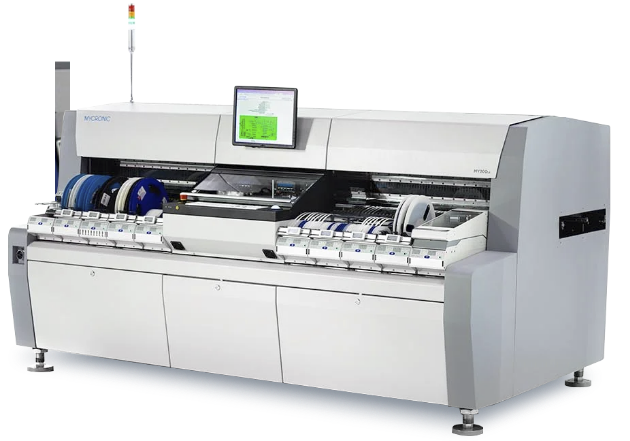
Why Mycronic Pick And Place Machines For Prototypes?

For most prototype builds and small-batch production, we use Mycronic (formerly Mydata) pick-and-place machines, along with Yamaha equipment. Mycronic machines offer precision, flexibility, and fast setup, making them ideal for high-mix, low-volume production of prototype PCBs.

Mycronic
  • Fast Setup & Changeover
    Ideal for handling multiple builds in a single day.
  • Flexible with Mixed Component Types
    Perfect for odd parts, mixed components, and one-off prototype builds.
  • Small Batch Efficiency
    Built to handle short strips, cut tape, and partial reels for low-volume prototype PCB assembly.
  • High-Precision Placement
    Supports fine-pitch components, micro-BGAs, and small passives, including 0.4 mm pitch devices, 0402, and 0201 components.
  • Low-Volume Efficiency
    Built for cost-effective small-batch production.

Prototype PCB Assembly: Do’s And Don’ts

Do’s

Provide complete and updated documentation to prevent errors and delays
  • Include Gerber files, drill files, BOM, pick-and-place files, and assembly drawings.
  • Make sure that all files are complete, current and in synch with each other.
  • Clearly mark all DNP (Do Not Populate) components.
  • Mark any parts that need to be manually placed or require special handling.
  • Provide notes for special build requirements.
  • Confirm that the BOM matches the design and pick-and-place files.
  • Mark polarity for all polarized components (diodes, capacitors, LEDs, and ICs) in assembly drawings and silkscreen to prevent incorrect placement.
Follow PCB design for assembly (DFA) guidelines
  • Use standard footprints and recommended pad sizes.
  • Add fiducials for automated assembly.
  • Leave enough space between components.
Order extra components and verify availability to make sure that the job can be completed without interruptions
  • Order extra parts to cover setup, handling, and rework.
  • Include extra passives, ICs, and critical components to avoid shortages.
  • Make sure all the parts are in stock before releasing the job.

Don’ts

Don’t assume all parts are available
  • Avoid using hard-to-find or obsolete parts.
  • Verify availability before finalizing the design.
Don’t provide incomplete or inconsistent files
  • Missing or inconsistent files can cause delays or build mistakes.
  • All documentation should reflect the final design revision.
Don’t order the exact number of components needed
  • Exact quantities leave no margin for loss or damage.
  • Even losing one small component can delay the entire assembly.
Don’t forget to design for manufacturability
  • Avoid placing components too close together.
  • Use standard footprints.
  • Make sure the design supports automated printed circuit board assembly.
Don’t omit prototype validation and testing
  • Prototype assembly helps identify design and manufacturing issues.
  • Rushing to production without testing can lead to costly problems.

Consignment (Kitted Assembly)

Avoid Prototype PCB Assembly Issues Caused By Components:

If you are supplying the components, it is standard practice to provide quantities above the exact amount required. This helps ensure a smooth build process, minimizes potential delays, and accounts for normal handling loss or damage. Typical recommended overages:

  • Passive 0402/0603/0805: +20–30% extra, or minimum 20–30 pieces
  • ICs in tape/reel packaging: +2–3 extra pieces
  • QFNs, BGAs, fine-pitch ICs: +1–2 extra pieces (more if in short tape)
  • Connectors or mechanical parts: +1 or +2 each
  • Expensive or rare components: Provide at least one spare, more if there’s risk of damage during rework

For prototype builds, order extra components to cover feeder waste, handling loss, and potential rework, since small batches typically experience higher loss rates. Supply components in proper packaging (preferably full reels), clearly label and organize everything, confirm orientation and polarity, and document any approved substitutions before the build begins.

Consignment (Kitted Assembly)

Prototype PCB Assembly, Frequently Asked Questions

FAQs
General Questions
Prototype printed circuit board assembly is the process of building a small quantity of printed circuit boards to check a design before full production. It allows PCB designers and engineers to verify that the board functions as intended, and any design issues are identified early.
Prototype quantities typically range from 1 to 50 boards, although some projects may require up to 100 boards.
Lead time usually ranges from 1 to 5 business days depending on board complexity, component availability, and quantity.
Design And Documentation
Typical required files include:
  • Gerber files
  • Bill of Materials (BOM)
  • Pick-and-place file also known as centroid file or XY data
  • Assembly drawings
  • Special instructions, if applicable
Yes, we perform a Design for Assembly (DFA) review to identify potential issues before production begins.
We will place the job on hold and contact the customer to clarify or correct the issue.
Components
Yes, if you are supplying the components (consigned or partially consigned assembly), you should provide extra components to help prevent delays due to feeder requirements, handling losses, or rework.
Yes, we offer full or partial component sourcing services.
We will suggest approved substitutes and wait for your approval before proceeding.
Yes, we support BGAs, QFNs, fine-pitch ICs, and other advanced packages.
Assembly Process
Yes. We use automated pick-and-place machines even for small prototype quantities to ensure accuracy and consistency.
Yes. Inspection methods may include:
  • Visual inspection
  • AOI (Automated Optical Inspection)
  • X-ray inspection for BGAs and leadless devices
Yes. Prototype assemblies can include both SMT and through-hole technologies.
Testing And Quality
Yes, electrical testing is available when test procedures or fixtures are provided. We also offer in-circuit testing (ICT). Please note that testing services are subject to additional charges.
Defects are corrected through rework, and boards are re-inspected to ensure quality.
Ordering And Production
Yes. Prototype builds are often used as the foundation for full production runs.
Yes. We protect customer intellectual property and offer NDA agreements if required.
Common causes include:
  • Missing or incorrect documentation
  • Component shortages
  • Insufficient extra components
  • Design or footprint errors
  • Provide complete and accurate documentation
  • Include extra components
  • Verify footprints and BOM accuracy
  • Respond quickly to questions from our assembly team